---
title: "Veneer vs Solid Wood: What's the Difference and Why it Matters"
description: Learn the key differences between solid wood and veneer furniture, their benefits, and how to choose the right material for your design needs.
image: https://blog.innerspacewa.com.au/hubfs/Leaf-Chair-Ton.webp
---
[](https://www.innerspacewa.com.au/)
- [Ready to Ship](https://www.innerspacewa.com.au/leadtime/ready-to-ship/)
- [About](https://www.innerspacewa.com.au/about/)
- [Services](https://www.innerspacewa.com.au/services/)
- [Projects](https://www.innerspacewa.com.au/projects/)
- [Shop by Brand](https://www.innerspacewa.com.au/brands/)
- [Shop by Designer](https://www.innerspacewa.com.au/designers/)
- [Contact](https://www.innerspacewa.com.au/contact-us/)
- [Ready to Ship](https://www.innerspacewa.com.au/leadtime/ready-to-ship/)
- [About](https://www.innerspacewa.com.au/about/)
- [Services](https://www.innerspacewa.com.au/services/)
- [Projects](https://www.innerspacewa.com.au/projects/)
- [Shop by Brand](https://www.innerspacewa.com.au/brands/)
- [Shop by Designer](https://www.innerspacewa.com.au/designers/)
- [Contact](https://www.innerspacewa.com.au/contact-us/)
# Veneer vs Solid Wood: What's the Difference and Why it Matters
### 29 July 2026
Timber is widely valued in furniture design for its warmth, durability and natural character. When selecting timber furniture, a common question arises: should it be solid wood or veneer?
Both approaches are widely used in quality furniture manufacturing, but they perform differently depending on how they are designed. Understanding the difference helps you make more informed decisions about appearance and long-term performance.
Rather than one option being inherently better than the other, each material offers advantages depending on the scale of the furniture and the design intent of the piece.
[](https://www.innerspacewa.com.au/products/merano-chair-by-ton/)
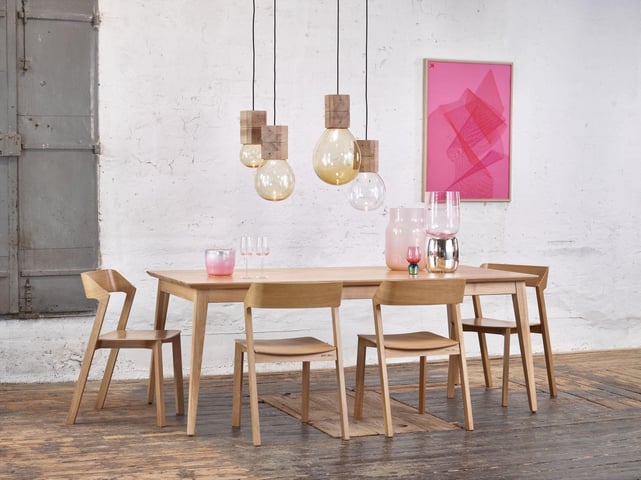
[Merano Chair by Ton](https://www.innerspacewa.com.au/products/merano-chair-by-ton/)
## **What is solid wood?**
Solid wood furniture is made from pieces of natural timber that have been milled from a tree and shaped into boards or structural components. These elements are joined together using traditional or precision woodworking techniques.
Because the timber runs through the full thickness of the material, the grain pattern remains consistent throughout the piece. This gives solid wood furniture its distinctive character and individuality.
Solid timber is often valued for its durability and longevity. When properly constructed, it can last for decades and may be refinished if surfaces become worn. Well-crafted seating pieces, like the [Merano Chair by Ton,](https://www.innerspacewa.com.au/products/merano-chair-by-ton/) highlight how solid timber construction can combine structural strength with refined design.
However, timber is a natural material that responds to environmental changes. Wood can expand and contract slightly with humidity and temperature, so furniture makers must account for this movement in their designs.
**What is veneer?**
Wood veneer is a thin slice of real timber applied to a stable substrate such as engineered timber or composite board.
The veneer layer provides the appearance of natural timber while the underlying structure provides strength and stability. Modern manufacturing techniques allow veneers to be cut extremely thin, meaning a single log can produce a much larger surface area.
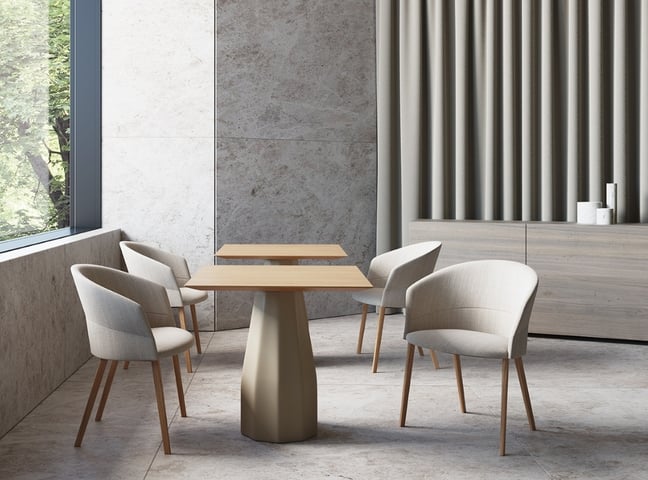
Veneer also allows designers to achieve consistent grain patterns across larger panels. This makes it particularly useful for tabletops, cabinetry and other surfaces where visual continuity is important. Products like the [Burin Table by Viccarbe](https://www.innerspacewa.com.au/products/burin-table-by-viccarbe/) demonstrate how veneer can create refined, durable surfaces while maintaining the appearance of natural timber.
[](https://www.innerspacewa.com.au/products/burin-table-by-viccarbe/)
[*Burin Table by Viccarbe*](https://www.innerspacewa.com.au/products/burin-table-by-viccarbe/)
## **Structural performance and durability**
One of the main differences between veneer and solid wood is how the materials respond to environmental conditions.
Solid wood naturally expands and contracts as humidity levels change. Skilled furniture makers design joinery that allows for this movement without affecting structural integrity. Veneer furniture uses stable substrates that reduce this movement. This makes veneer particularly suitable for larger surfaces where dimensional stability is important.
In both cases, durability depends largely on the quality of construction and finishing rather than the material alone.
## **Aesthetic and design considerations**
Veneer and solid wood showcase the natural beauty of timber, but they allow for different design outcomes.
Solid wood highlights the individuality of the material, with natural variations in grain and colour giving each piece a unique appearance.
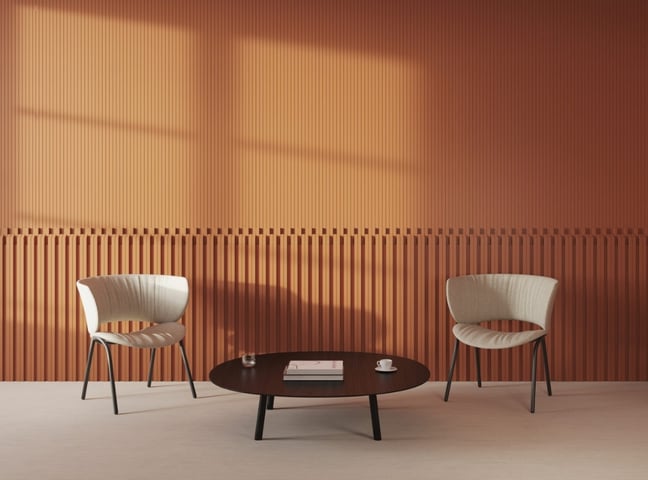
Veneer allows greater control over visual consistency. Grain patterns can be matched across surfaces to create balanced compositions that would be difficult to achieve using solid boards alone.
[](https://www.innerspacewa.com.au/products/maarten-low-table-by-viccarbe/)
[Maarten Low Table by Viccarbe](https://www.innerspacewa.com.au/products/maarten-low-table-by-viccarbe/)
## **Sustainability and material efficiency**
Both veneer and solid timber can be sustainable choices when responsibly sourced. Solid timber furniture can remain in use for many years, particularly when well made and properly maintained.
Veneer offers material efficiency because thin slices of timber are used. This allows a single log to produce significantly more usable surface area.
## **Where each material is typically used**
Solid wood is commonly used for structural components like chair frames, legs and joinery elements where strength is essential.
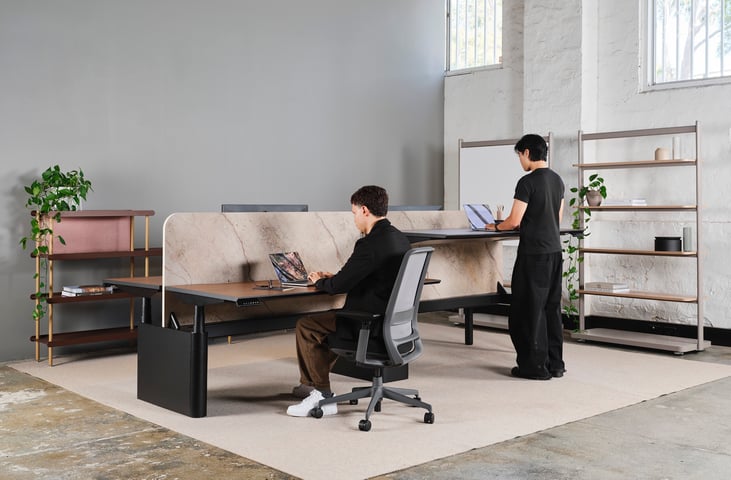
Veneer is often used for larger surfaces including tabletops and workstation panels where stability and consistent grain patterns are required. Contemporary workspace solutions like the [DuO Too Workstation by 31 Degrees](https://www.innerspacewa.com.au/products/duo-too-workstation-by-31-degrees/?_gl=1*guk5f3*_gcl_au*MzQyNTE1ODg4LjE3ODQ1OTU5MTg.) often incorporate these material approaches to balance durability and visual refinement.
Many contemporary furniture pieces combine both materials to balance structural performance with refined surface finishes.
## [**](https://www.innerspacewa.com.au/products/duo-too-workstation-by-31-degrees/)
[Duo Too Workstation by 31 Degrees](https://www.innerspacewa.com.au/products/duo-too-workstation-by-31-degrees/)
## **Choosing between veneer and solid wood**
Choosing between veneer and solid wood depends on the needs of the project.
Solid timber is preferred when natural material expression and craftsmanship are priorities. Veneer can provide greater stability and design flexibility for larger surfaces.
Understanding how each material performs helps ensure furniture is selected for its appearance and its long-term function.
### Share this article:
[‹ Return to Blog](https://blog.innerspacewa.com.au/)
[](https://www.innerspacewa.com.au/)
**Sydney showroom**
2 Boundary Street
Paddington NSW 2021
[View map](https://www.google.com/maps/place/Level+1%2F2+Boundary+St,+Paddington+NSW+2021/@-33.8791563,151.2252871,17z/data=!3m1!4b1!4m6!3m5!1s0x6b12ae0eb275579f:0x1df7e79258a36ac9!8m2!3d-33.8791563!4d151.2274758!16s%2Fg%2F11qpklrhbd?entry=ttu)
Ph: [+61 2 8072 9340](tel:+61%202%208072%209340)
Mon – Fri: 9am – 5pm
(ex public holidays)
Saturday: 10am – 2pm
[Contact Us](https://hello.innerspacewa.com.au/contact-us)
**Melbourne showroom**
17 Bedford Street
Collingwood VIC 3066
[View map](https://www.google.com/maps/place/17+Bedford+St,+Collingwood+VIC+3066,+Australia/@-37.800252,144.984686,16z/data=!4m6!3m5!1s0x6ad6431fc1c37575:0x50df3893157c3504!8m2!3d-37.8002519!4d144.9846861!16s%2Fg%2F11cs7kprz5?hl=en&entry=ttu)
Ph [+61 3 7002 8810](tel:+61370028810)
By Appointment Only
[Contact Us](https://hello.innerspacewa.com.au/contact-us)
**Perth showroom**
509 Murray Street
Perth WA 6000
[View map](https://goo.gl/maps/wAjCwcqcnWkxAEJV7)
Ph [+61 8 9322 6664](tel:+61893226664)
Mon – Fri: 9am – 5pm
(ex public holidays)
Saturday: 10am – 4pm
[Contact Us](https://hello.innerspacewa.com.au/contact-us)
**Subscribe to our newsletter**
© 2026 Innerspace Commercial Interiors
**[FAQs](https://hello.innerspacewa.com.au/frequently-asked-questions)**
**For Home**
- [Living](https://www.innerspacewa.com.au/collections/living/)
- [Dining](https://www.innerspacewa.com.au/collections/dining/)
- [Bedroom](https://www.innerspacewa.com.au/collections/bedroom/)
- [Home Office](https://www.innerspacewa.com.au/collections/designer-home-office-furniture/)
- [Outdoor](https://www.innerspacewa.com.au/collections/outdoor/)
- [Lighting](https://www.innerspacewa.com.au/collections/designer-lighting/)
- [Homewares](https://www.innerspacewa.com.au/collections/homewares/)
**For Business**
- [Workplace](https://www.innerspacewa.com.au/collections/workplace/)
- [Healthcare and Aged Care](https://www.innerspacewa.com.au/collections/healthcare-aged-care/)
- [Education](https://www.innerspacewa.com.au/collections/education/)
- [Hospitality](https://www.innerspacewa.com.au/collections/hospitality/)
- [CUA](https://www.innerspacewa.com.au/cua/)
- [Clocks](https://www.innerspacewa.com.au/collections/clocks/)
- [Rugs](https://www.innerspacewa.com.au/collections/rugs/)
- [Decorative](https://www.innerspacewa.com.au/collections/decorative/)
- [Terms and Conditions](https://www.innerspacewa.com.au/terms-and-conditions/)
- [Delivery Policy](https://www.innerspacewa.com.au/delivery/)
- [Returns Policy](https://www.innerspacewa.com.au/returns-policy/)
- [Warranty](https://hello.innerspacewa.com.au/warranty)
- [Privacy Policy](https://www.innerspacewa.com.au/privacy-policy/)
- [Care and Maintenance](https://blog.innerspacewa.com.au/hubfs/Innerspace%20Care%20%26%20Maintenance%20Manual%20OCT2023%20.pdf)
- [FAQs](https://hello.innerspacewa.com.au/frequently-asked-questions)